
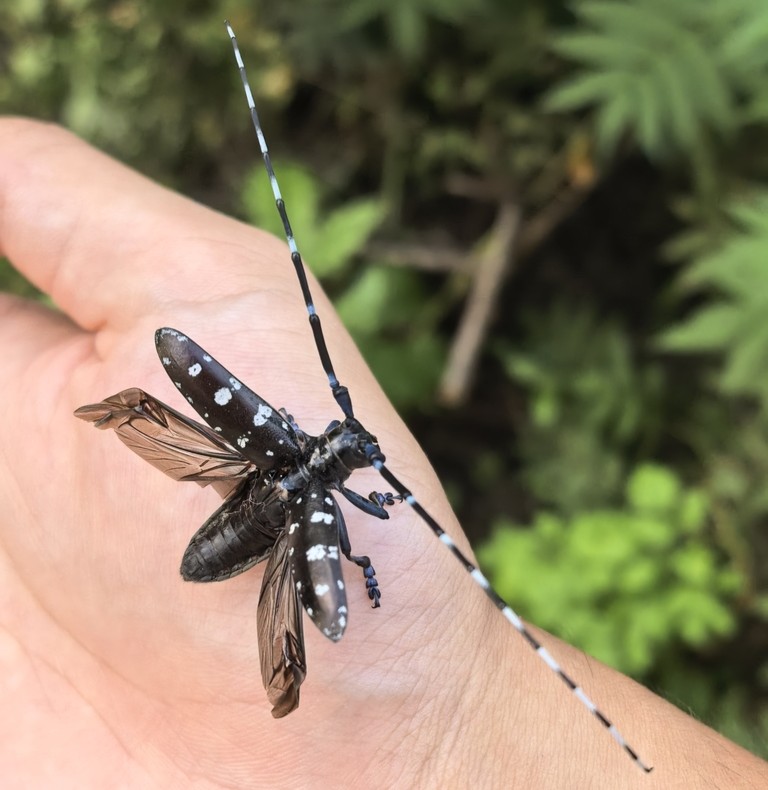
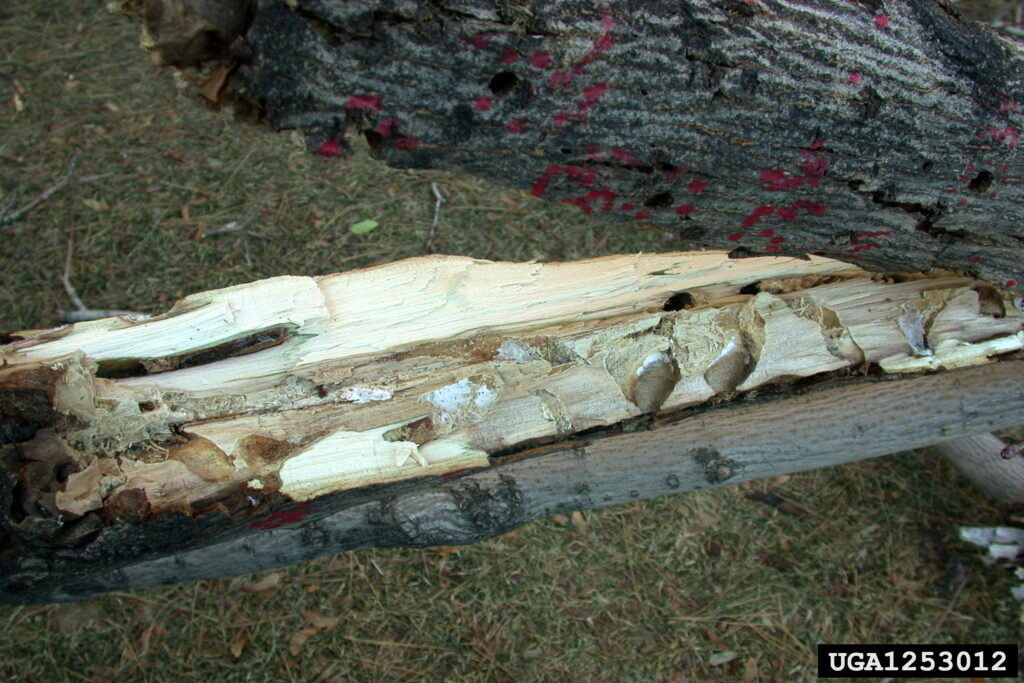
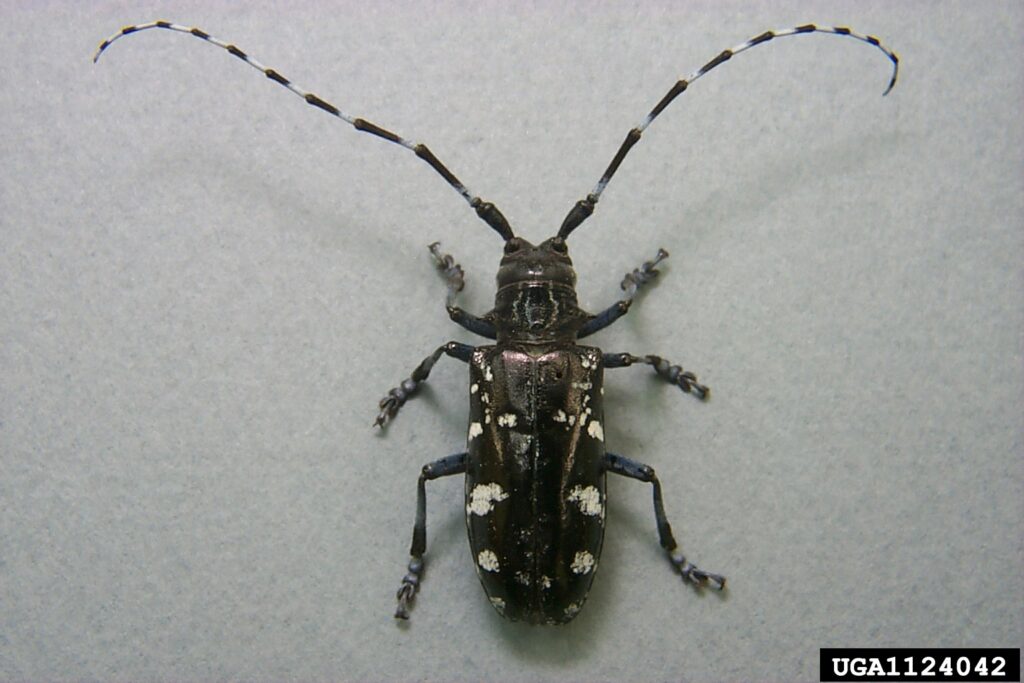
Adult Asian Long-horned Beetles have a shiny black colouration with irregularly occurring white spots on their elytra (hard protective wings). This distinct colouration has earned them their other name, “Starry Sky Beetle”. Their bodies are 20-35 mm, and they have large antennae that are 1.5 to 2 times longer than their body length. Their antennae are segmented, with each segment featuring a bluish-white base. They have a prominent spine on each side of the thorax (middle body segment). The larvae are round, grub-like, and cream-coloured. When the adults emerge, they create large circular exit holes (6-15 mm). Other signs and symptoms include chewed pits about 10 mm in diameter, where females lay a single egg, and sawdust that may be visible at the base of trees.
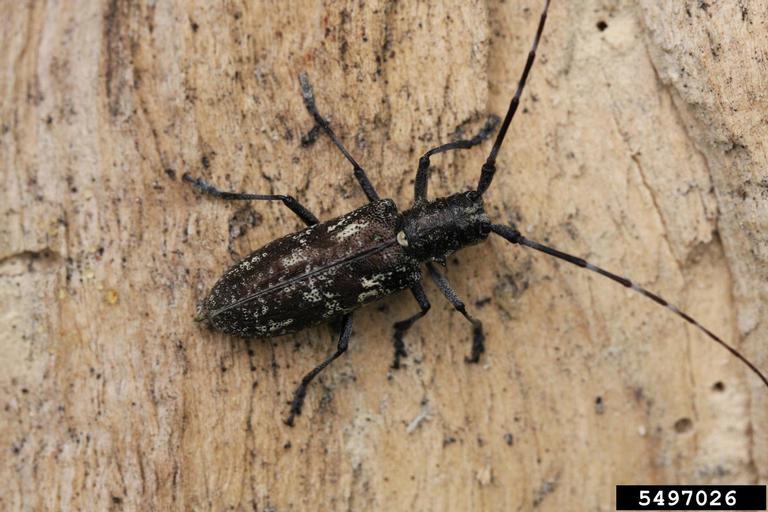
The native Whitespotted Sawyer Beetle (Monochamus scutellatus) is often mistaken for this species. It can be distinguished from the Asian Long-horned Beetle by its smaller size and the single white spot centred at the base of its elytra.
Asian Long-horned Beetles in North America feed on a variety of tree species, including Maple (Acer), Willow (Salix), Poplar (Populus), Birch (Betula), Horse Chestnut (Aesculus), Mountain Ash (Sorbus), and Elm (Ulmus) trees. Maple trees appear to be the most attacked tree species. This beetle’s entire life cycle is closely tied to their host trees and will attack both healthy and stressed trees. Eggs are laid in a host tree’s bark, and when they hatch, the larvae will begin eating the inner tissues of the tree. This feeding disrupts the essential flow of water and nutrients, causes structural damage, and eventually kills the tree. Once they progress to the adult stage of their life cycle, they will chew an exit hole out of the tree. Adult beetles will then feed on foliage and twigs of the host trees. The presence of Asian Long-horned Beetles can result in entire tree stands being decimated. This invasive beetle’s host species are common deciduous trees in Canadian forests and urban centers. The ecological and economic impacts of this species are predicted to be extremely high. It is estimated that the cost of removing and replacing infested trees will be $10 billion CAD, and an annual loss of $800 million in maple timber and syrup production.
Asian Long-horned Beetles are native to East Asia and were first detected in North America in the 1990s. They can be introduced to North America through contaminated wood used for pallets, boxes, and other shipping containers. A breeding population of this species was discovered in Canada in 2003 in Toronto, followed by the detection of a second population in Mississauga in 2013. Thanks to a rapid response, it was deemed successfully eradicated from Canada in 2020, after five years of no detections. However, this species has several breeding populations in the Eastern United States that have not been eradicated. This species can spread locally through flight as an adult. The movement of infested wood products, such as firewood, can spread this species over long distances.
The native Whitespotted Sawyer Beetle (Monochamus scutellatus) is commonly mistaken for the Asian Long-horned Beetle. Note the single white spot at the centre of the elytra that distinguishes this species.
Large beetle 20-35 mm long (excluding antenna); Segmented antennae 1.5-2x longer than body and with alternating black and white colouration; body is a black coloration with a white dotted elytra.
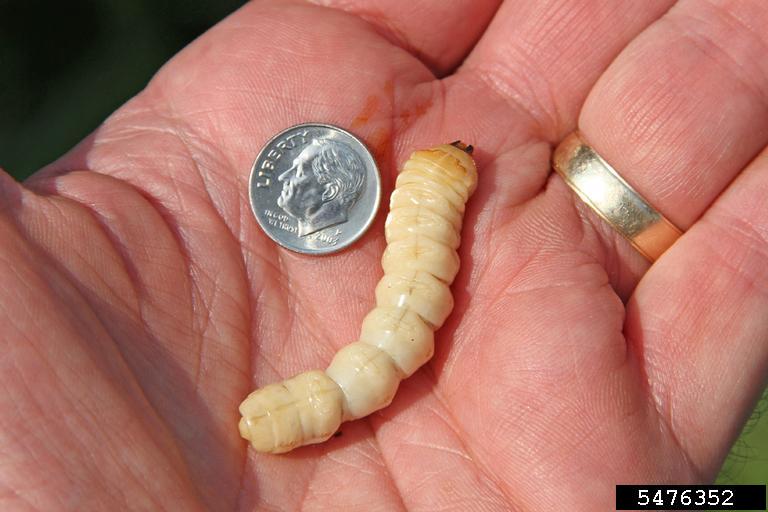
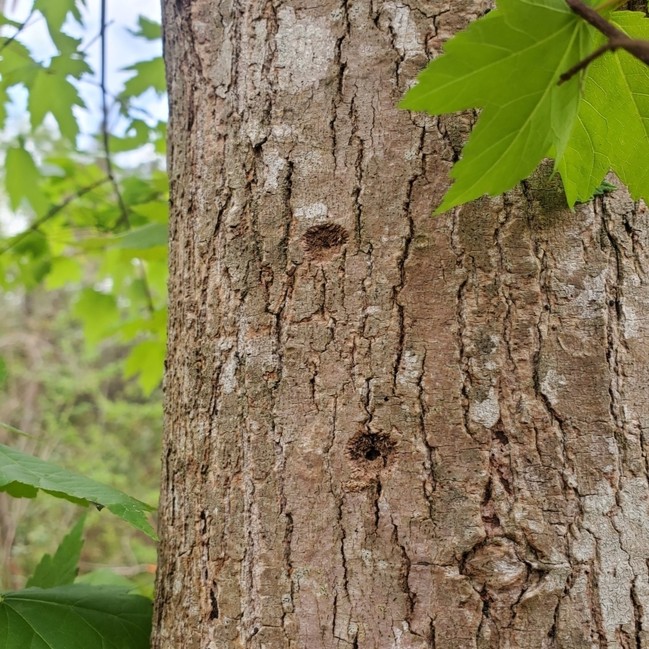
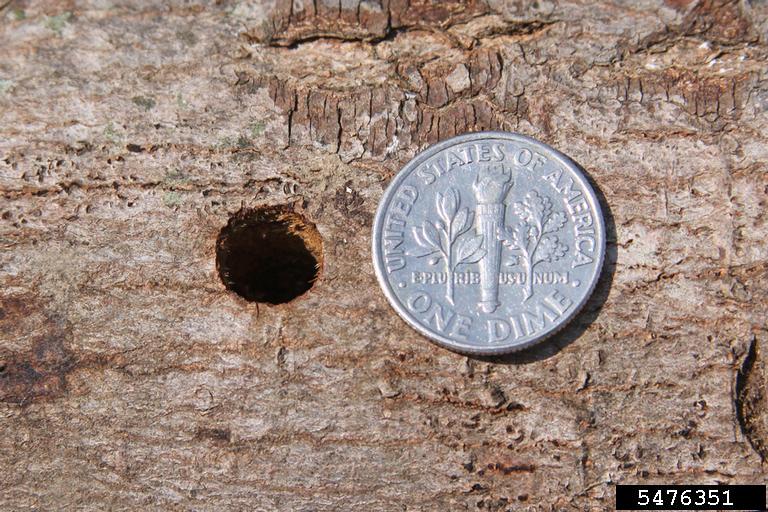
Asian Long-horned Beetles develop at different rates depending on their surrounding temperatures. Higher temperatures can accelerate the hatching of eggs, as well as increase the rate of growth for Asian Long-horned Beetle larvae and pupae.
To keep the Asian Long-horned Beetle out of the province, it is crucial to buy local, burn local, and refrain from moving firewood. This species, and other wood-boring insects, live and lay their eggs within trees. By moving firewood, you can unknowingly spread it to previously uninhabited areas.
If you think you may have spotted an Asian Long-horned Beetle, capture it if possible or take photos of the symptoms, and please report it immediately to the Canadian Food Inspection Agency (CFIA) or to the NSISC.